風浪.愛.苦難(Storms, Love and Suffering)
導覽選項
-
Youtube 視頻導覽按我
-
English Audio Guide
當我創作這幅《風浪‧愛‧苦難》的時候,我心裡想的,不只是風浪,也不只是苦難,而是人在生命裡面,如何被 愛 支撐著走過去。
這幅畫的左邊,是人生的苦難。你可以看到那裡的顏色比較深,比較重,黑色、褐色、暗紅色、深綠色交錯在一起,像是一層一層壓下來的重量。那些垂直流下來的線條,對我來說像 眼淚,也像傷痕; 有時候人生的痛苦不是一下子來的,而是一點一點累積,慢慢把人包圍。
它可能是失去、孤單、病痛、關係的破裂…,也可能是說不出口的壓力、傷痛…。那一大片沉重的色彩,就是我對苦難的感受:混亂、黏稠、沉重,好像人被困在裡面,很難自己走出來。
而畫面的右邊,是風浪。我用了比較多白色、藍色、黑色交錯的線條,它不是安靜的海,而是一種翻騰、不穩定、充滿衝擊的狀態。那些線條互相纏繞、碰撞,好像風在吹,浪在翻,人站在其中,根本無法完全掌控方向。風浪代表外在環境的變化,也代表生命中突如其來的挑戰。有時候我們以為自己已經站穩了,可是一陣風、一個浪打過來,就讓我們重新感受到自己的有限。
但是這幅畫真正的中心,不是苦難,也不是風浪,而是中間這一道橘黃色與白色交織的愛。
我把愛放在畫面的中央,而且讓它從上到下流動下來。橘黃色有溫度,像火,也像光;白色有潔淨、安慰和盼望的感覺。祂不是一個很安靜、很柔弱的愛,而是一種能夠穿透黑暗、進入痛苦、也能夠面對風浪的愛。這份愛不是停在畫面外面觀看,而是進到人的苦難和風浪之中。祂是流下來,滲透進去,把左右兩邊連接起來。
我想表達的是:人生不會因為有愛,就完全沒有苦難;也不會因為有愛,風浪就立刻停止。但是因為有愛,人就有力量繼續走下去。愛不是把所有問題立刻拿走,而是在最困難的地方托住我們;愛也不是讓生命變得沒有風浪,而是在風浪中給我們方向、給我們勇氣、給我們不放棄的理由。
所以這幅畫裡的愛,不是裝飾性的光,而是整幅畫的核心。左邊的苦難很重,右邊的風浪很亂,但是中間的愛讓畫面不至於崩塌。它像一條生命的通道,也像一個從天而來的支撐。當人被苦難壓住、被風浪包圍的時候,真正能讓人穿越過去的,不一定是自己的能力,而是那份仍然存在、仍然流動、仍然沒有離開的愛。
上帝說,在世上,你們有苦難;但你們可以放心,我已經勝了世界。
上帝還說,就是在患難中也是歡歡喜喜的;因為知道患難生忍耐,忍耐生老練,老練生盼望;盼望不至於羞恥。
《風浪‧愛‧苦難》對我來說,是一幅關於生命真實處境的畫。
它不否認痛苦,也不美化風浪;
可是它也不讓苦難成為最後的答案。
因為在苦難與風浪之間,還有愛。
只要愛仍然在中間,人就還有可能被扶持、被醫治,並且繼續往前走。
| Artist(藝術家) | |
|---|---|
| Media(媒材) | |
| Size(尺寸) | |
| Frame(畫框) |
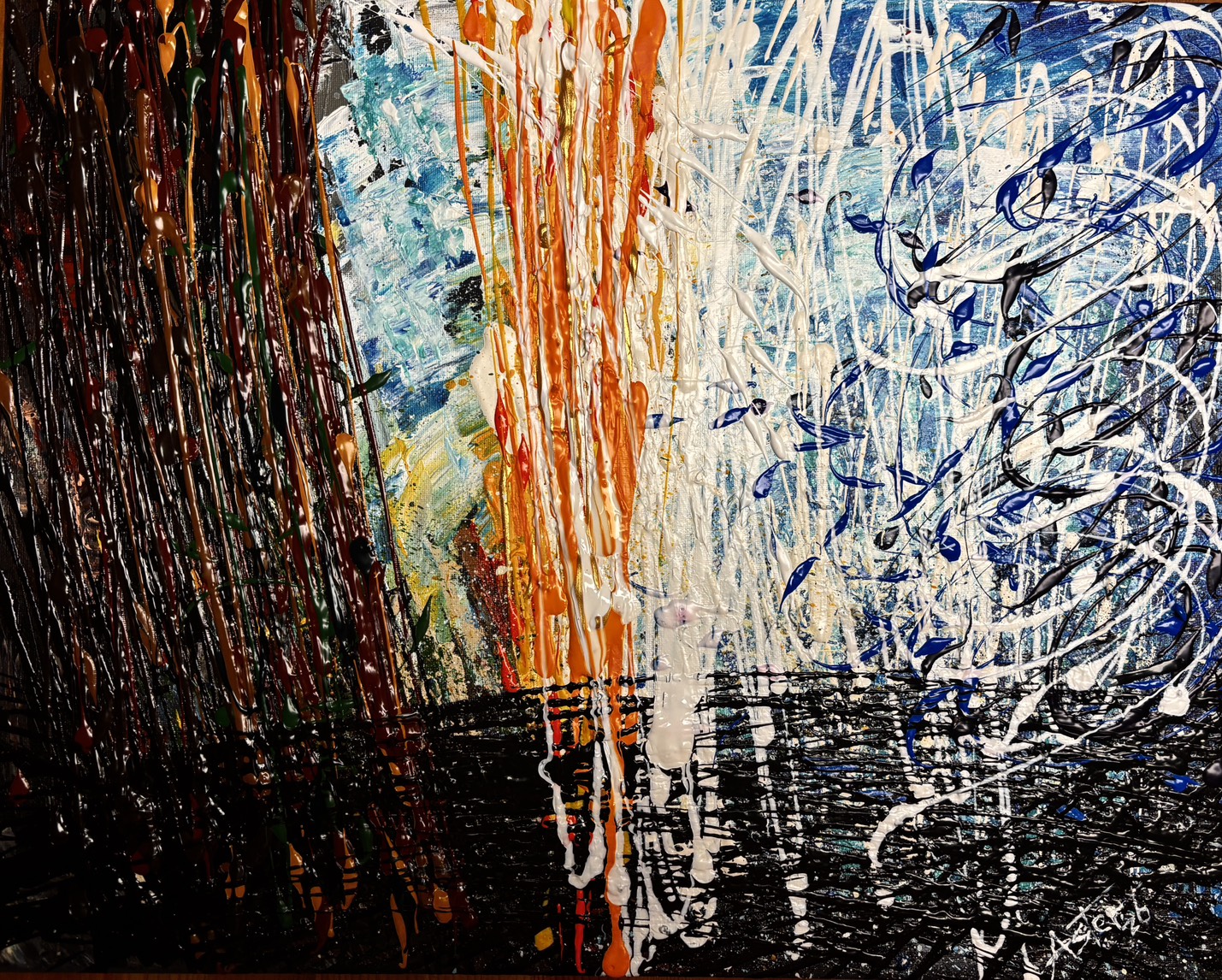
“When I was creating this piece, ‘Storms, Love, and Suffering,’ what I was thinking about wasn’t just the storms, and it wasn’t just the suffering. It was about how a person is carried through life, held up entirely by love.
On the left side of the canvas is the suffering of life. You can feel that the colors here are darker and heavier—blacks, browns, dark reds, and deep greens overlapping each other like layers of crushing weight. Those vertical lines dripping down? To me, they look like tears, and they look like scars. Sometimes, the pain of life doesn’t hit you all at once; it builds up bit by bit, slowly wrapping itself around you.
It could be loss, loneliness, sickness, or a broken relationship… or maybe a heavy, unspoken pressure or trauma. That massive patch of heavy color is exactly how suffering feels to me: chaotic, sticky, and suffocating. It feels like you’re trapped inside, and it’s incredibly hard to climb out on your own.
Then, on the right side of the canvas, are the storms. I used overlapping lines of whites, blues, and blacks. This isn’t a quiet sea. It is a churning, unstable, and violent state. Those lines twist and crash into each other, like the wind howling and the waves roaring. When you stand in the middle of it, you realize you have absolutely zero control over your direction. The storms represent the shifting of our external environment and the sudden, brutal challenges in life. Just when we think we are standing on solid ground, a sudden gust of wind or a massive wave hits, forcing us to realize just how limited we really are.
But the true center of this painting isn’t the suffering, and it isn’t the storms. It is this vertical stream of love woven with orange-yellow and white right in the middle.
I placed love at the absolute heart of the canvas, letting it flow all the way from the top to the bottom. That orange-yellow carries a physical warmth—it feels like fire, and it feels like light. The white brings a sense of purity, comfort, and hope. This isn’t a quiet, fragile kind of love. It is a love that pierces through darkness, steps into pain, and looks the storms right in the eye. This love doesn’t just sit on the sidelines and watch. It enters into our suffering, plunges into our storms, flows down, seeps in, and binds both sides together.
What I want to say is this: life doesn’t become completely free of suffering just because love exists. And the storms don’t magically stop the moment love arrives. But because of love, we find the strength to keep walking. Love doesn’t take away all our problems instantly; it holds us up at our lowest points. Love doesn’t wipe the storms from our lives; it gives us direction, courage, and a reason not to give up while we are in the middle of them.
So, the love in this painting isn’t just a decorative light. It is the core that holds everything together. The suffering on the left is heavy, and the storms on the right are chaotic, but the love in the center keeps the entire canvas from collapsing. It acts like a gateway of life, a divine pillar of support from above. When you are crushed by suffering and surrounded by storms, what truly carries you through isn’t necessarily your own strength—it is that love that still exists, still flows, and refuses to leave your side.
Scripture says, ‘In this world you will have trouble. But take heart! I have overcome the world.’
And it also says, ‘We also glory in our sufferings, because we know that suffering produces perseverance; perseverance, character; and character, hope. And hope does not put us to shame.’
To me, ‘Storms, Love, and Suffering’ is a painting about the raw reality of life.
It doesn’t deny the pain, and it doesn’t sugarcoat the storms. But it refuses to let suffering have the final word.
Because between the suffering and the storms, love is still there. As long as love remains at the center, it is always possible for us to be held, to be healed, and to keep moving forward.”